Why the Renewal of Society Begins with Marriage as a Sacrament and Vocation to Holiness
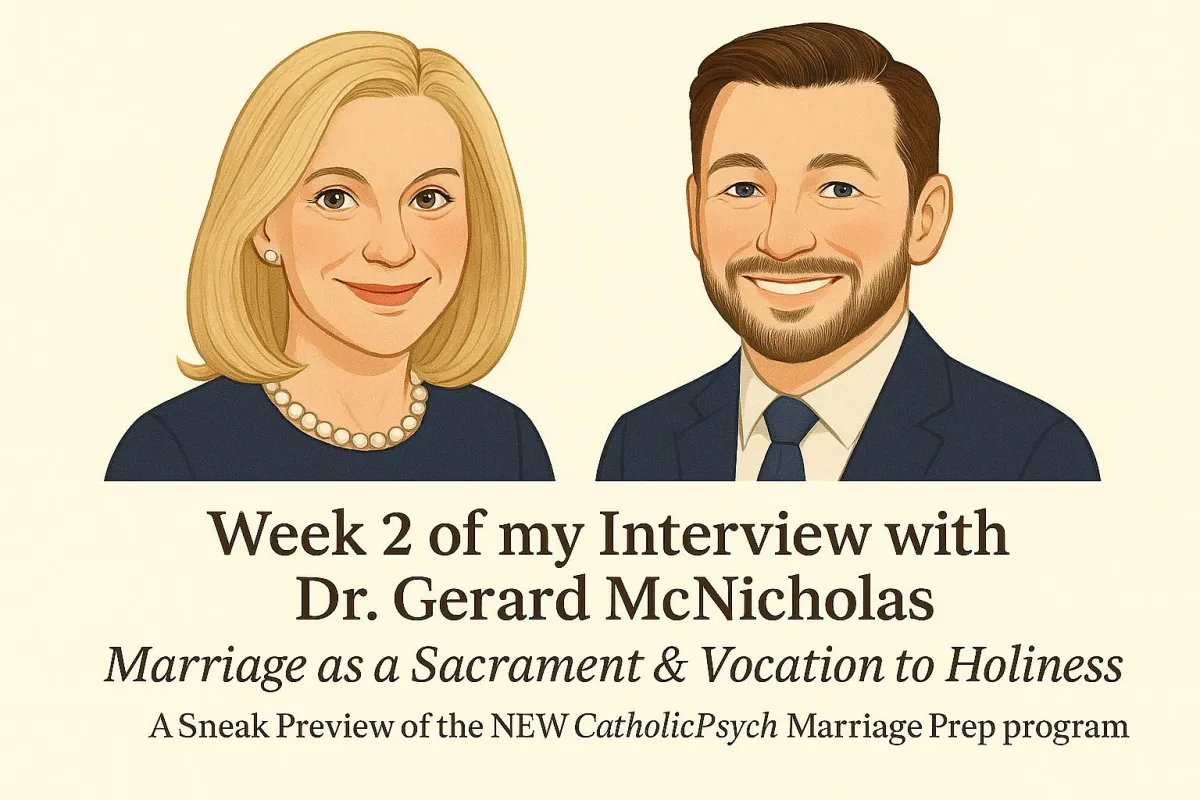
Week 2 – Conversations with Dr. Gerard McNicholas
Why the Renewal of Society Begins with Marriage as a Sacrament and Vocation to Holiness
In a world shaken by division, the path to renewal begins not in politics, but in the covenant of marriage and the family, the heart of God’s plan for humanity.
Marriage in the Catholic Church is not just a personal promise. It is a covenant sealed by Christ Himself. When spouses say, “I do,” their union is infused with a grace that endures through every season of life. I know this not only from study but from 35 years of marriage: that grace doesn’t erase challenges. It transforms them. It doesn’t make marriage easy. It makes it holy.
The Church teaches that in the sacrament of Matrimony, Christ dwells with spouses. His presence strengthens them to forgive, to rise after falling, to bear one another’s burdens, and to love with supernatural tenderness. Marriage is not simply a path to happiness, but a lifelong call to holiness.
Marriage as a Sacrament
In a culture that often views marriage as a contract for personal fulfillment, the Church proclaims something far greater: marriage is a visible sign of Christ’s covenant with His Church.
Sacramental grace is like spiritual oxygen. It enables couples to forgive, show humility, and love tenderly when human strength runs out. This grace transforms everyday life into sacred ground.
Sharing a meal. Listening with patience. Forgiving after an argument. These ordinary moments become encounters with Christ, who strengthens and sanctifies a couple’s love. And that grace is what turns the ordinary into the sacred, reminding couples that even the smallest act of love participates in something eternal.
Marriage as a Vocation to Holiness
Every Christian is called to holiness, but for married couples, that call is lived out primarily within their vocation. Holiness is not achieved in dramatic gestures or spiritual highs. It is forged in the daily rhythms of ordinary life: raising children, balancing work and family, forgiving small offenses, and serving each other with love.
Marriage forms what the Church calls the domestic church, a home where faith and love are lived, practiced, and passed on. In this way, marriage is not only for the good of the spouses themselves, but also a mission that shapes future generations and ripples out into the wider Church and society.
A Conversation with Dr. Gerard McNicholas: Integrating Psychology and Spirituality
Kristin: How does seeing marriage as a sacrament change the way couples approach daily life?
Dr. Gerard: When couples understand the grace they receive, they can start seeing challenges not as threats but as opportunities to grow together in love. Psychology backs this up, especially in how couples tell their story.
In a landmark study, Dr. John Gottman found that couples who “glorify the struggle”, telling their story as a shared adventure rather than a string of setbacks, are far more likely to stay together. That mindset builds unity, hope, and resilience. By contrast, couples who told their story as one long season of chaos were much more likely to drift apart.
Kristin: That’s so striking, because we tell couples preparing for marriage the same thing: their story is caught up in something bigger than just two people trying to make it work. It's a vocation. How does seeing marriage this way change the way couples live it out?
Dr. Gerard: It shifts the whole frame. It moves couples from asking, “Am I happy right now?” to asking, “What are we building together?” Gottman calls this a “shared meaning system”, the rituals, values, and sense of purpose that give direction to a couple’s life.
Spiritually, that’s what vocation is: a God-given mission that makes even the ordinary holy. Couples with this mindset are more resilient, grateful, and less shaken by setbacks because they see their life as a story being co-written with God.
When Growth Comes Through Suffering Together
What Dr. Gerard describes rings true in my own marriage. Now in my 35th year, I can see clearly that holiness has never been about perfection but about daily sacrifice.
In the early years, it meant struggling to make ends meet, merging two very different family cultures, and discovering what it meant to put our marriage above the demands of careers, extended family, and friends. Those were years of learning to die to myself and surrender for the sake of the other.
During the years of raising children, sacrifice took on a different shape. We worked hard to provide for our children and for each other’s needs, often burning the candle at both ends. But I also came to realize that I am responsible for my own feelings, emotions, and behaviors because they directly affect those I love most. That awareness reminded me how much we all need mentors and spiritual directors to help us see our blind spots and grow into more Christlike love.
Now, as empty nesters, we are blessed to enjoy the fruits of those years: children grown, grandchildren arriving, more time to travel and enjoy one another. Yet even now, the vocation calls us to sacrifice in new ways, caring for aging parents, facing our own aging, and keeping faith life at the center. Every season has carried pruning and suffering, but also abundant fruit.
“Growth in marriage rarely comes in the easy seasons. It comes through suffering together.”
In the worst of times, not the best, we became who God created us to be. In good times and in bad, the struggle itself became the path to holiness, the way God has been shaping us into saints through the vocation of marriage.
A Call to Renew Marriage and Family
Marriage as a sacrament means Christ infuses daily life with grace.
Marriage as a vocation means spouses are called to sanctify one another through small, faithful acts of love.
Theology, psychology, and lived experience all converge on this truth: marriage flourishes not by avoiding hardship, but by allowing grace to transform hardship into holiness.
If our society is going to heal, marriages must be strengthened. Families must be supported. The domestic church must once again shine as a light to the world.
This is why I believe so deeply in the CatholicPsych Marriage Prep Program. It’s not just content. It’s formation. It’s not just theory. It’s lived experience.